Can Machines Be Creative?
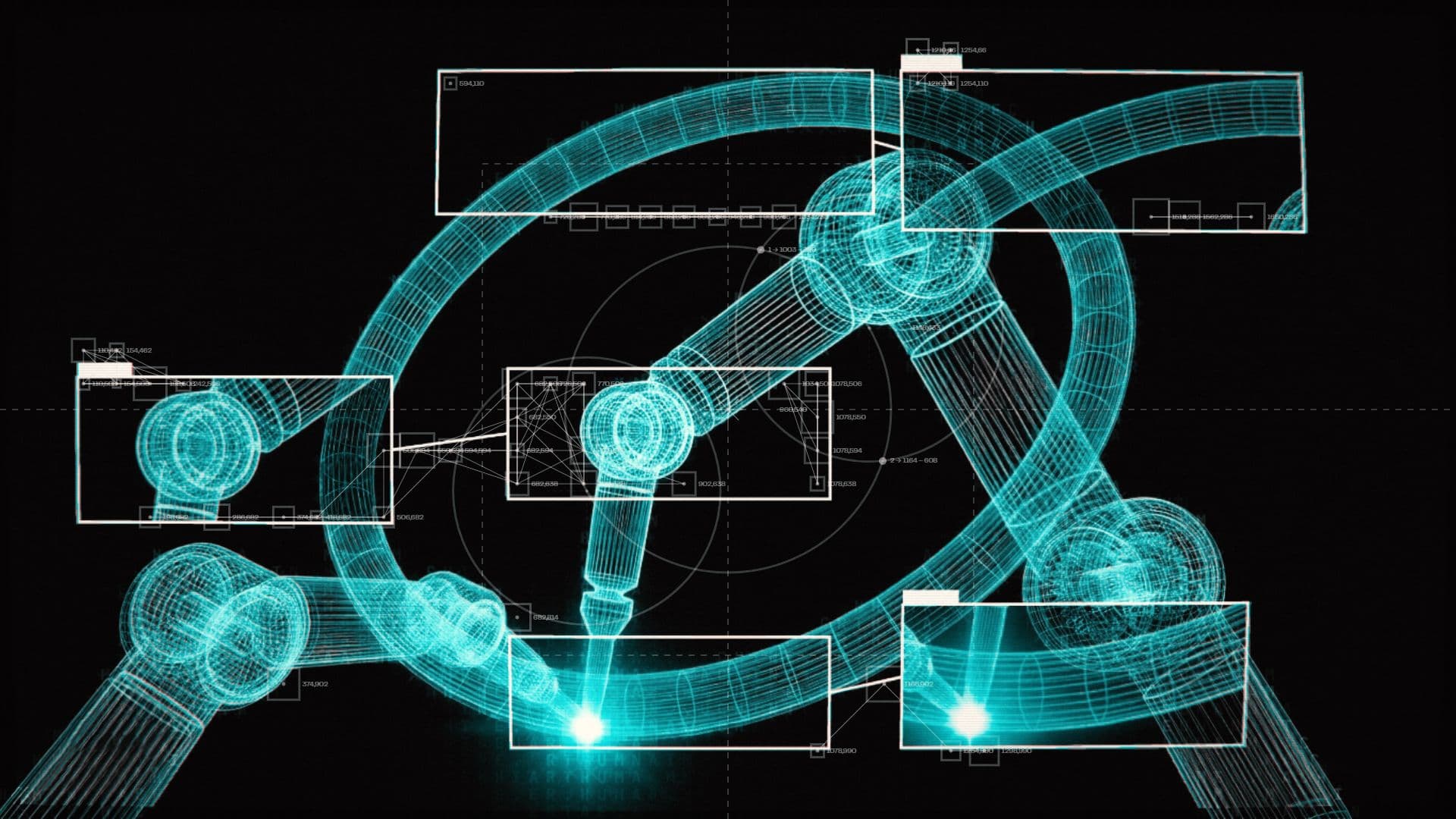
Can a Machine Be Creative?
This is not simply a question about technology. It is also part of a much older discussion about the nature of creativity, the role of the artist, and where intention begins within a work of art.
For centuries, art has been understood as an expression of how humans perceive the world. A painter's brushstroke or a composer's melody was long considered evidence of a uniquely human capacity for creativity. Yet the relationship between computers and art is not new. Long before artificial intelligence, artists and researchers had already begun exploring computers not merely as calculating machines, but as tools for discovering new visual languages.
Today, machines have evolved beyond systems that simply execute instructions. Some produce unexpected outcomes, generate their own visual structures, and encourage us to rethink how art can be made. But are they truly creative? Or are they simply prompting us to reconsider what creativity itself means?
The First Digital Traces of Creativity
The first experiments in computer art during the 1960s laid the foundation for many of the questions we continue to discuss today. One of the pioneers of this period was Michael Noll, who created experimental computer graphics at Bell Labs in the United States. His work raised a fundamental question: if the decisions behind an image are made by a system rather than entirely by a human, can the result still be considered art?
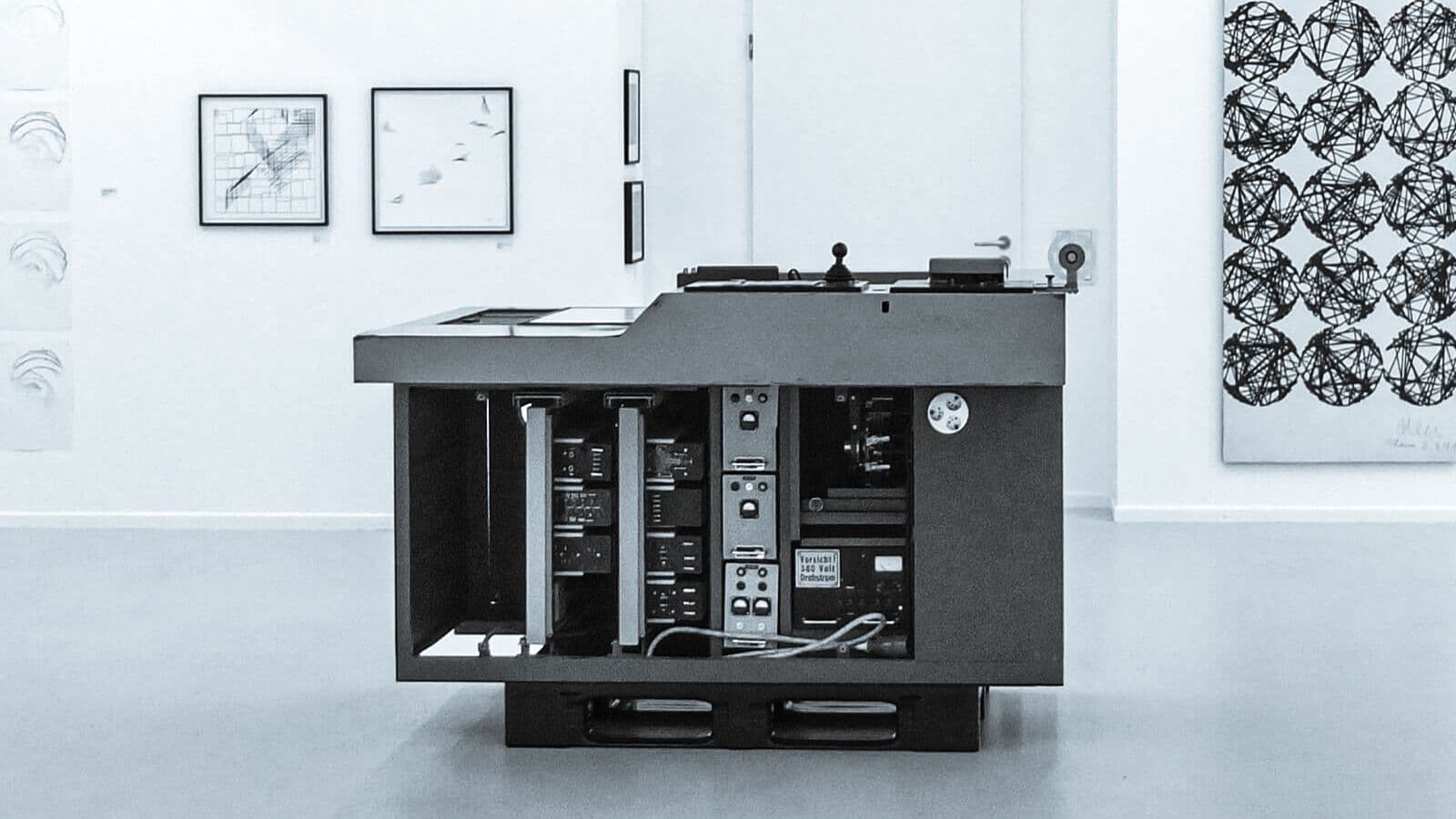
At the same time in Germany, mathematicians such as Georg Nees and Frieder Nake were transforming the computer into an artistic medium. In particular, Nees's work with the ZUSE GRAPHOMAT, one of the world's first automated drawing machines, demonstrated that digital instructions could become physical marks. Mathematical processes that previously existed only on a screen or in memory became visible through the movement of a real pen across paper.
These developments were more than technical innovations. They challenged conventional ideas about how art is created. Many of today's drawing robots and computational art practices trace their roots back to the pioneering experiments of the early "3N" generation: Noll, Nees, and Nake.
During this period, some artists and researchers viewed computers not only as tools for generating new images, but also as instruments for studying creativity itself. In 1968, the Japanese artist and researcher Hiroshi Kawano argued that computer art could "reveal the secrets of artistic creation, clarify artistic thinking and theory, and lead artists toward a better understanding of the human role in the creative process." His perspective suggests that computer art is not only about producing new visual forms, but also about investigating the nature of creativity itself.
Creativity That Can Be Described
One of the central questions in discussions about machine creativity is this: which parts of artistic practice can actually be described?
Harold Cohen's AARON system remains one of the most influential attempts to explore this question. Cohen was not trying to make a computer behave like a human artist. Instead, he wanted to understand how a computer could create visual work according to its own way of operating.
AARON was not simply an image generator. It was a system built around rules, relationships, and decision-making processes. Whenever part of a creative process can be clearly described, some aspects of it can be transferred to another system. If an artist can explain their methods, preferences, rules, and decisions, then part of that process becomes computable. But becoming computable does not mean that meaning itself has been fully explained.
This leads to another important question. If creativity could be completely described and taught, what would remain?
If something can be taught in its entirety, it suggests that we understand it thoroughly. The process becomes explainable, repeatable, and eventually routine. This is precisely where art becomes interesting. Art is not only about following existing rules. Sometimes it is about inventing entirely new ones.
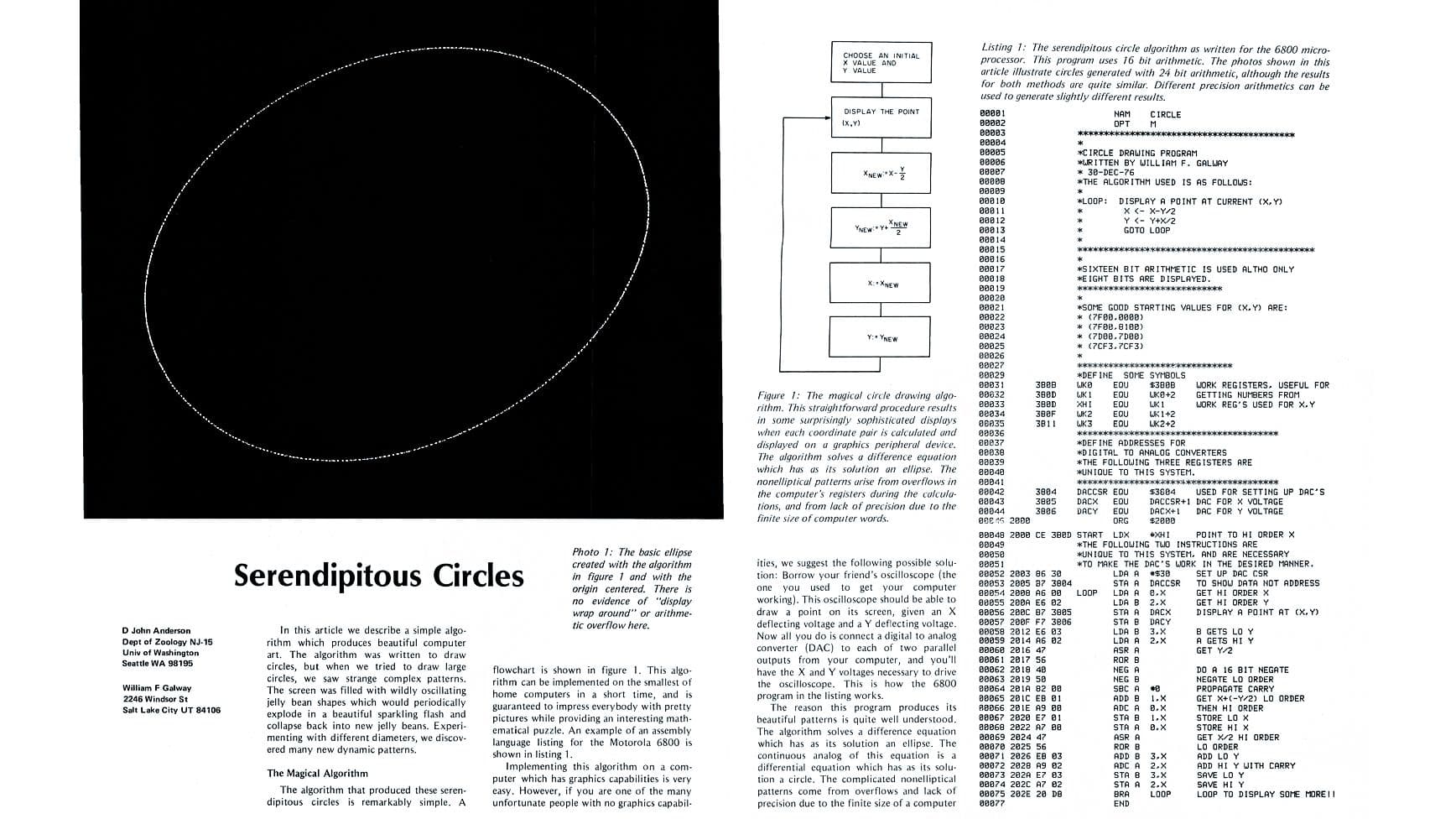
In Serendipitous Circles, William F. Galway and D. John Anderson demonstrated that a simple difference-equation algorithm written in assembly language for the Motorola 6800 microprocessor could generate unexpectedly complex geometric patterns. These patterns emerged from the computer's own computational behavior, including integer arithmetic, overflow, and limited numerical precision.
The Machine as an Extension of the Artist
Many discussions about machine art begin with a flawed assumption: that machines should create in the same way humans do.
Computers are not human, and there is no reason they should be. That does not mean they are incapable of producing art. It simply means they do so differently.
The camera never tried to become a painter. The synthesizer never tried to become a piano. Likewise, computers do not need to imitate humans in order to make art. Every new tool introduces its own possibilities for expression and its own aesthetic language. Just as new materials have shaped new artistic movements throughout history, new technologies can give rise to entirely new forms of artistic practice.
Rather than viewing the machine as an independent artist, it may be more meaningful to see it as an extension of the artist's thinking.
A brush extends the artist's hand. A camera extends the artist's vision. An algorithm can extend the artist's way of thinking.
For those interested in seeing how artists worked during this period, the following short documentary offers an excellent glimpse into the process.
▶ 1966 | Frieder Nake Making Digital Art on an SEL ER-56 Computer
So, Are Machines Really Creative?
Perhaps this has been the wrong question from the very beginning.
It assumes that creativity can only be measured by how closely something resembles human behavior. But computers are not human. The real question is not how closely they imitate us, but what new forms they can create precisely because they are different.
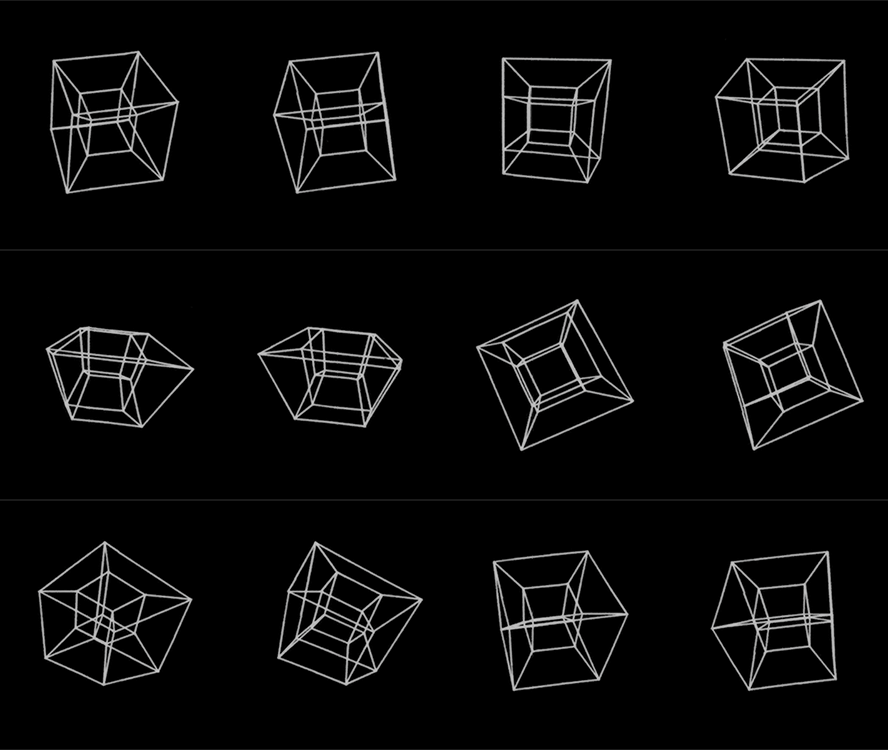
Machine art may not be fully understood using the standards developed for earlier artistic practices. Every new tool changes not only what can be created, but also the questions we ask.
One of the greatest achievements for any artist is finding their own voice. Constantly imitating others rarely leads to genuinely original work. Once you understand your own boundaries and possibilities, you no longer need to repeat someone else's path. Otherwise, the work gradually ceases to be truly your own.
The same applies to machines. If we continue to judge them only by how closely they resemble humans, we overlook what makes them valuable. Perhaps the most interesting aspect of creative systems is that they force artists to define their own thinking more clearly. A machine can only operate on information and processes that have been expressed in a form it can understand. In doing so, creative systems offer more than new tools. They challenge us to rethink and redefine our own creative process.
Let us return to the question we asked at the beginning.
Can a machine be creative?
More than sixty years of computer art has not produced a definitive answer. Instead, it has revealed something far more interesting.
Perhaps the real question is not whether machines are creative, but how we define creativity itself.
Machines produce form, not meaning.